Lenders quote you a mortgage for the same Washington home. One offers a lower interest rate, and the other asks for less money at closing.Which one costs less? The answer depends on what
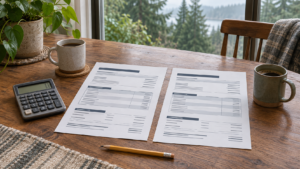 each lender charges up front, what you’ll pay each month, and how long you expect to keep the loan. Learning how to compare Loan Estimates puts those numbers side by side. Grab a calculator and a coffee. The coffee is optional, even in Washington.
Compare Loan Estimates using the same assumptions
Ask each lender for an estimate based on the same property, purchase price, down payment, loan type and term. For example, if one estimate is for a 30-year fixed-rate loan with 5% down, ask the other lender to use those same assumptions. Request the estimates around the same time because rates can change from one day to the next. On page one, check whether each rate is locked and, if it is, when the lock expires. If you have a closing deadline, ask whether the lock covers it and what an extension would cost. CFPB guide to comparing loan offers
Page one shows the monthly payment
Start with the projected total monthly payment. Check principal and interest, mortgage insurance if applicable, and the amount set aside in escrow for property taxes and homeowners insurance. If one lender estimates lower taxes or insurance for the same property, ask where that number came from. A smaller estimate for insurance can make the payment look more attractive even though you still need to pay the premium your insurer quotes.
For a condo or a home in an association, check the HOA dues and whether they’re collected separately. Write down your expected monthly housing cost with any separately paid dues, taxes or insurance included. Then budget for utilities and maintenance alongside that number. The lender’s payment figure is one line in the household budget, and your checking account gets to vote on the rest. CFPB Loan Estimate explainer
Page two shows what the loan costs up front
Look at origination charges in Section A, services you cannot shop for in Section B, and any lender credit in Section J. Ask whether the offer includes discount points. Points are an upfront charge that typically buys a lower rate. A lender credit can lower your upfront costs and may come with a higher rate. If the two quotes use different combinations, ask both lenders to show comparable options so you can see what you’re paying for the rate.
Suppose one offer costs $2,400 more up front and saves you $60 a month in principal and interest, with the other terms and costs held equal for this example. Divide $2,400 by $60 and you get 40 months. That’s a rough break-even point. If you sell or refinance before then, the payment savings would fall short of the extra upfront charge. If you keep the loan longer, the lower payment has more time to pay off. The example is illustrative and ignores factors such as the timing of payments and differences in remaining loan balances. CFPB guide to upfront lender costs and five-year comparisons
Check what you’ll actually bring to closing
Find Estimated Cash to Close near the bottom of page two. It takes into account your down payment, closing costs, any earnest money deposit already paid and reflected on the form, applicable seller credits, and other adjustments. If a figure surprises you, ask the lender to walk through the calculation line by line. If you’re exploring Washington State Housing Finance Commission assistance, ask a participating lender for a side-by-side comparison with and without assistance. Ask what you would bring to closing, what you would pay each month, and whether the assistance carries a separate balance or repayment terms. CFPB Loan Estimate explainer · Washington State Housing Finance Commission homeownership resources
Ask your lender the same three questions
- What will I pay each month after I account for taxes, insurance and any separately billed HOA dues?
- How much cash should I plan to bring to closing, and which figures are still estimates?
- Which fees or credits would change if I chose a different rate or needed a longer rate lock?
Keep the estimate you select and compare it with the Closing Disclosure when it arrives. If the cash to close or monthly payment changes, ask your lender to identify the specific line items and explain what changed before you sign. CFPB Closing Disclosure explainer
Want to practice reading the numbers before you’re on a closing deadline? Register for a Washington homebuyer education class at EducateHomeBuyers.org. Bring your questions about loan options, closing costs or down payment assistance.
Washington First-Time Homebuyers, Loan Estimate, Mortgage Shopping, Closing Costs, Cash to Close, Homebuyer Education